How Much Does It Cost to Run a Space Heater? We Did the Math
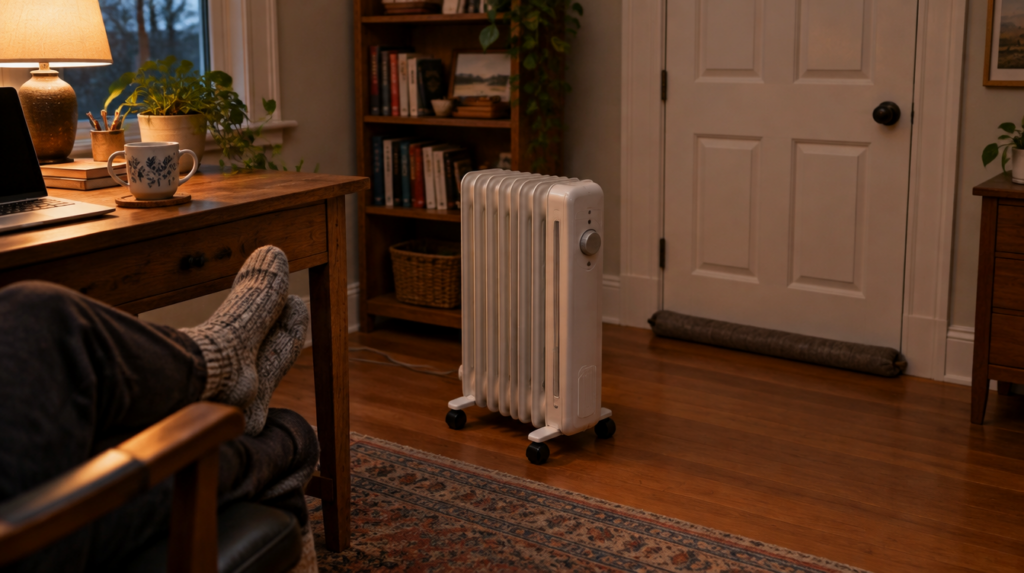
Twenty-seven cents. That is what one hour of a standard 1,500-watt space heater costs at the average US residential electricity rate of 18.31 cents per kilowatt-hour, the figure the US Energy Information Administration reported for July 2026. It sounds like nothing. Leave the heater running eight hours a day for a month and it becomes about $66.
So how much does it cost to run a space heater? For most households, somewhere between $25 and $70 a month per heater, and far more in a high-rate state. The bigger question is whether that money replaces part of your heating bill or simply gets added on top of it. Most cost guides skip that part, and it decides whether the heater is a bargain or a leak.
The formula fits on a sticky note
Every electric space heater turns electricity into heat at the same rate, so the math does not care about the brand, the shape or the marketing. You need three numbers: the wattage on the label, the hours you run it, and the price per kWh printed on your electric bill.
Divide the watts by 1,000 to get kilowatts. Multiply by hours of use, then by your rate. The Missouri Department of Natural Resources uses the same formula in its consumer guide to space heaters, and its example is a 1,500-watt heater run for 10 hours at 10 cents per kWh, which comes to $1.50.
Run that same example at today’s national average and it is $2.75 a day. Rates have moved a lot, which is why we would not trust any cost article that still quotes a 2022 rate. Check your own bill before you trust ours.
What a space heater costs per month, room by room
We ran the most common household scenarios at three rates from the same EIA table: the US average (18.31 cents), the cheapest state in the July 2026 data, Louisiana (12.72 cents), and the most expensive, Hawaii (48 cents). Most readers will land somewhere between the first two columns.
| How you use it | Setting and hours | kWh per month | US average | Louisiana | Hawaii |
|---|---|---|---|---|---|
| Evening TV in the living room | 1,500 W, 3 hours | 135 | $24.72 | $17.17 | $64.80 |
| Bedroom overnight on low | 750 W, 8 hours | 180 | $32.96 | $22.90 | $86.40 |
| Home office, heater at full power | 1,500 W, 8 hours | 360 | $65.92 | $45.79 | $172.80 |
| Garage workshop or all-day use | 1,500 W, 16 hours | 720 | $131.83 | $91.58 | $345.60 |
| Electric blanket instead | about 150 W, 8 hours | 36 | $6.59 | $4.58 | $17.28 |
All figures assume a 30-day month and the heater drawing full power the whole time. That last assumption is the one that makes most online estimates too high, and it deserves its own section.
Your heater is probably not running full blast
A heater with a built-in thermostat shuts the element off once the room reaches the set temperature, then switches it back on as the room cools. In a small, reasonably sealed room, the element may only be on for a fraction of each hour. If it runs half the time, the $66 home office drops to about $33.
Nobody can tell you your exact duty cycle without a meter, because it depends on the room’s size, insulation, windows and the temperature outside. A plug-in electricity monitor costs around $20 to $30 and shows real kWh after a few days of normal use. If you plan to rely on a heater all winter, we think that small purchase pays for itself in clarity alone.
The opposite also happens. A heater in a drafty room with a single-pane window may never reach its set point and will run nonstop. If your heater never clicks off, the problem is the room, and the fix is weatherstripping or a heavy curtain, not a bigger heater.
When a space heater lowers your bill, and when it raises it
This is the part that matters for your wallet. The Missouri guide is blunt about it: electric resistance heat is the most expensive form of heating, and heating a whole house that way generally costs more than a natural gas furnace or a heat pump. A space heater is still 100% efficient at the point of use. Efficient and cheap are not the same thing.
The same guide makes the point most cost articles miss. A space heater saves money only if you turn the central thermostat down at the same time. Run one in the den while the furnace keeps the whole house at 70°F and you have added a second heating bill on top of the first.
Here is how we would decide.
- Use one if you spend most of the day in one room, can drop the central thermostat by several degrees, and the rest of the house can stay cool.
- Skip it if you have a heat pump that already heats the room. A heat pump moves heat rather than making it, so in mild weather it typically delivers two to three times as much heat per kWh as any space heater.
- Rethink it if the heater is filling in for a room the central system never reaches. That is a duct, vent or insulation problem, and the heater is paying rent on it every month.
Oil-filled, ceramic or infrared: same cost per unit of heat
Product pages love to call one heater type more economical than another. At the same wattage, they are not. A 1,500-watt oil-filled radiator, a 1,500-watt ceramic fan heater and a 1,500-watt infrared panel each turn 1.5 kWh of electricity into roughly 5,100 BTUs of heat every hour they run at full power. Physics does not offer a discount for the shape of the box.
What differs is how the heat reaches you. A ceramic fan heater warms the air quickly, which suits a room you use for an hour or two. An oil-filled radiator is slow to warm up but keeps radiating after its element clicks off, so it feels steadier and is close to silent, which is why we like it for bedrooms. Infrared and radiant heaters warm the person and objects in front of them instead of the whole room. That can let you sit comfortably with the heater on a lower setting, which is a real saving, but only if you actually stay in its line of fire.
Be wary of any heater sold on a claim that it will cut your heating bill by a large percentage. Those numbers almost always compare heating one room with a space heater against heating the whole house with central heat. The saving comes from heating less space, not from the heater.
Four ways to pay less without being colder
Start with the cheapest heat in the table. An electric blanket or heated mattress pad draws a fraction of what a space heater does, and warming your body costs far less than warming a room. If the goal is a warm bed, a heated pad at about $7 a month beats a bedroom heater at $33.
Next, use the low setting and the thermostat. Most heaters offer 750 and 1,500 watts. Bring the room up to temperature on high, then switch to low and let the thermostat do the rest.
Then shrink the space. Close the door. Put a draft stopper at the bottom of it. Pull heavy curtains at night. Every cubic foot you do not heat is money you keep.
Finally, if your utility offers time-of-use pricing, look at when the cheaper hours fall. Running the heater during off-peak hours can cut the per-hour cost noticeably on some plans. Your bill or your utility’s website lists the rate windows.
If space heaters are a sign that your whole electric bill is getting out of hand, our piece on backyard power setups and rising energy bills looks at the other side of the equation. We used the same do-the-math approach in our breakdown of what it really costs to digitize VHS tapes, if you like checking the numbers before you spend.
The safety cost is the one people forget
Space heaters cause a small share of heating fires and a large share of the deaths. According to the US Fire Administration, portable heaters were involved in only 3% of home heating fires from 2017 to 2019 but in 41% of the fatal ones. Heating was the second leading cause of home fires in 2021, with an estimated 32,200 fires and 190 deaths.
The agency’s rules are simple. Keep anything that can burn at least 3 feet away from the heater, including bedding, curtains and sofas. Turn it off when you leave the room or go to bed. We would add two habits: plug the heater straight into a wall outlet rather than a power strip or extension cord, and buy a model with tip-over and overheat shutoff. A heater without those features is not a bargain at any price.
That overnight bedroom line in our table assumes a heater built for unattended use on its lowest setting. If yours is an older model without automatic shutoff, the heated mattress pad is both the cheaper and the safer choice.
Your next step takes two minutes. Find the price per kWh on your latest electric bill, multiply it by 1.5, and you have the hourly cost of your heater on high. Then decide which room deserves it, and turn the central thermostat down by the same amount you are adding back in that one room.
Space heater costs: frequently asked questions
About 27 cents at the US average residential rate of 18.31 cents per kWh reported by the EIA for July 2026. In Louisiana, the cheapest state in that data, it is about 19 cents. In Hawaii it is about 72 cents.
Only when you heat one room and turn the central thermostat down at the same time. Heating a whole house with electric resistance heat generally costs more than a gas furnace or heat pump.
Not at the same wattage. Both turn electricity into heat at the same rate. Oil-filled models hold heat longer after the element cycles off and run quietly, which can make a lower setting feel comfortable.
A 750-watt setting for 8 hours uses 6 kWh, about $1.10 a night at the US average rate, or roughly $33 a month. A heater with a working thermostat in a small room will often cost less than that.
The US Fire Administration advises turning space heaters off when you go to bed. If you need warmth overnight, an electric blanket or heated mattress pad uses far less electricity and avoids the clearance risk.

