Snap-on veneers pros and cons: an honest look before you order

A single porcelain veneer costs between $900 and $2,500 per tooth, according to WebMD’s veneer guide, with an average around $1,500. Multiply that by the six to eight teeth that show when you smile and you are looking at the price of a used car. That gap is the whole reason snap-on veneers exist, and it is also why so many people search for the catch before they order a set.
Here is our short version of the snap on veneers pros and cons. The upside is real: no drilling, no shots, a much lower price and a smile you can take out at night. The downside is just as real: they are a removable plastic cover, they can trap food and plaque against your teeth, and they do nothing to fix a tooth that is actually sick. If your teeth and gums are healthy and your problem is how they look, snap-ons can make sense. If something hurts, wobbles or bleeds, a dentist comes first.
Disclosure: Let’s Check It Now may earn a commission or have a business relationship with brands mentioned in this article. This never changes what we recommend.
What a snap-on veneer actually is
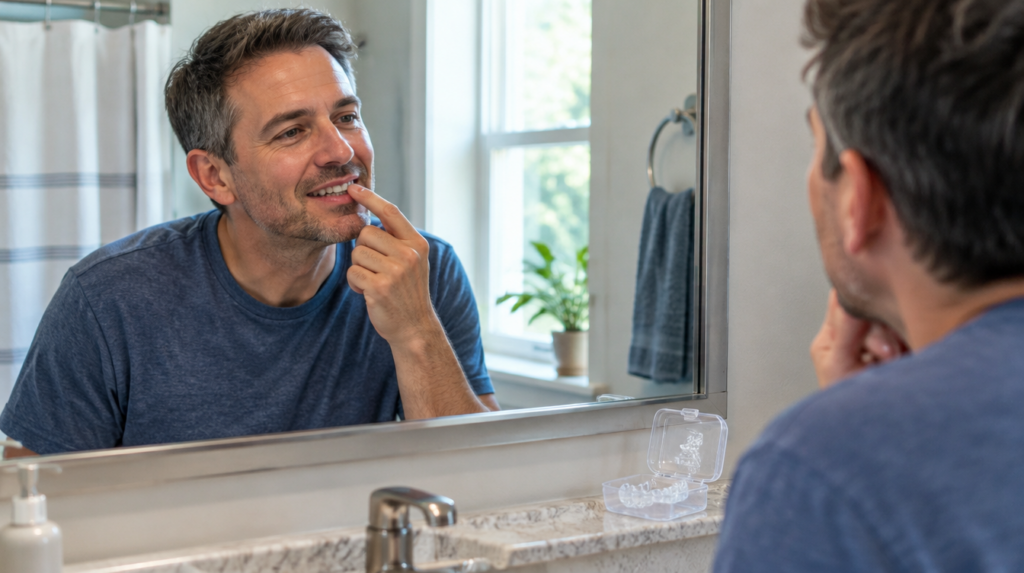
Forget the word veneer for a second, because it confuses the conversation. A traditional veneer is a thin shell of porcelain or composite that a dentist bonds permanently to the front of a tooth, usually after removing a layer of enamel roughly as thick as the shell itself. A snap-on veneer is closer to a very thin, tooth-colored mouthguard. It is molded from an impression of your teeth, covers the whole arch, and clicks over your natural teeth by friction.
Most online brands now work the same way. They mail you an impression kit, you press trays of putty onto your upper and lower teeth at the kitchen table, you mail the molds back, and a lab makes an arch in dental-grade thermoplastic resin. NewMouth’s dentist-reviewed roundup puts their typical lifespan at two to five years, against ten to fifteen for porcelain.
That distinction matters for everything that follows. Nothing is glued, nothing is removed from your teeth, and nothing is permanent. That is the best and the worst thing about the product.
The real advantages
The first advantage is cost, and it is not small. Even dentist-made composite veneers run about $800 per tooth according to WebMD, and insurance usually treats all veneers as cosmetic and pays nothing. A full arch of snap-ons is priced per arch rather than per tooth, which is where the savings come from.
The second is that the process is reversible. Porcelain veneers are a one-way door, because once enamel is removed it does not grow back, and those teeth will need a covering for life. With a snap-on you can test whether you even like a brighter, more even smile before you consider spending thousands on something permanent. We think this is the most underrated reason to try them.
Speed and comfort count too. There are no injections and no chair time, and the result is immediate the moment the arch goes in. For a wedding, a job interview or a stretch of time while you save for real dental work, that is a reasonable trade.
Finally, snap-ons can cover several cosmetic problems at once: stains that whitening will not lift, small chips, uneven edges and gaps. Some brands can also fill the space of a missing front tooth across the arch, although that is a cosmetic fill, not a replacement. We compared that use case in our piece on snap-on veneers versus dentures.
The downsides nobody puts in the ad
The biggest risk is hygiene, and dental professionals are consistent about it. An ADA News summary of expert warnings on the social-media snap-on trend lists the problems plainly. The shells can trap food particles against the teeth, which raises the risk of decay and gum disease. They can still damage enamel. And they do not match the quality of porcelain. If you snack or sip sweet coffee with the arch in, you are holding sugar and bacteria against your teeth for hours.
Fit is the next problem. A dentist shapes a bonded veneer to the gum line with great precision. A lab working from a putty impression you took yourself cannot. A slightly long edge can press on the gums, and a slightly loose arch can shift when you talk. Early discomfort usually fades as you get used to the arch, but some people never stop noticing it.
Then there is the close-up test. Snap-ons are a single piece, so they tend to lack the tiny shadows between teeth that make a smile read as natural. In photos and at conversation distance, a good set looks fine. Under bright light at close range, people who know teeth can often tell.
And the price advantage shrinks with time. A set that lasts two to five years has to be replaced, and an arch that cracks on an apple has to be replaced sooner. Over ten years the gap between snap-ons and porcelain narrows, although it does not close.
Who should skip them
This is the part we feel strongest about. Snap-on veneers hide problems, and hiding a problem in your mouth tends to make it more expensive later. Gum disease is not rare. The CDC reports that about 4 in 10 US adults over 30 have some level of periodontitis, a figure that climbs to about 60% of adults 65 and older and about 62% of current smokers. Plenty of those people have no idea.
So before ordering, be honest about these signs. If any apply, see a dentist first and treat the cause:
- Gums that bleed when you brush or floss, or look red and puffy
- A tooth that feels loose or has shifted
- Pain when you bite, or sensitivity that lingers after hot or cold
- Visible decay, a broken filling or a cracked tooth
- Braces or another fixed appliance still in place
- A bite that already feels off, or jaw pain and clicking
NewMouth’s reviewers add people with several missing or loose teeth, severe misalignment and a misaligned jaw to that list. We would also be cautious if you grind your teeth at night, because grinding is hard on any veneer and a thin plastic arch is no exception.
How the options compare
Snap-ons only make sense next to the alternatives, so here is the comparison we would want in front of us. Prices are typical ranges from the sources linked above and vary a lot by city and dentist.
| Option | Typical cost | Lasts | Changes your teeth? | Best for |
|---|---|---|---|---|
| At-home whitening | Tens of dollars | Months, with touch-ups | No | Yellowing on otherwise good teeth |
| Snap-on veneers | Priced per arch, far below porcelain | 2 to 5 years | No, removable | Healthy teeth with stains, chips or gaps |
| Composite veneers | About $800 to $1,100 per tooth | 5 to 7 years | Usually some enamel removed | A few teeth, mid-range budget |
| Porcelain veneers | $900 to $2,500 per tooth | 10 to 20 years | Yes, enamel removed for good | Long-term change on healthy teeth |
Read the table from the top. If your only complaint is color, whitening is cheaper than any veneer, and we cover the gentler ways to do it in our guide to teeth whitening without sensitivity. Snap-ons start to make sense when the problem is shape, chips or gaps that whitening cannot touch, and when you are not ready to commit to something permanent.
If you decide to try a set
For readers whose teeth and gums are healthy and who want a cosmetic change without commitment, a custom arch made from an impression is the reasonable middle ground. One example is custom snap-on veneers from Shiny Smile, which, according to the company, are made from an at-home impression, fit over your own teeth with no drilling or dentist visit, and cover stains, gaps and chips for a fraction of what porcelain costs. NewMouth places the brand in its budget tier. Like everything in this category, it is a removable cosmetic cover. It does not treat gum disease, decay or loose teeth, and anyone with those should skip it and book a dental exam instead.
Whatever brand you choose, a few habits decide whether the arch helps or hurts:
- Take the impression slowly and follow the timing exactly. A rushed mold is the usual cause of a poor fit.
- Brush and floss your real teeth before the arch goes in, every time.
- Take it out to eat, and drink only water while wearing it.
- Rinse and gently brush the arch daily with a soft brush and cool water. Hot water can warp thermoplastic.
- Do not sleep in it unless the maker says the product is designed for that.
- Keep your regular dental checkups and tell your dentist you wear it.
On the cleaning point, a dirty brush used on a clean arch defeats the purpose, which is one more reason to take toothbrush hygiene seriously. We looked at how much bacteria a toothbrush can carry in a separate piece.
What we would not pay for
We would skip boil-and-bite veneers from a drugstore shelf or marketplace listing, the one-size trays you soften in hot water and press on yourself. They are cheap for a reason. They rarely fit well, and a poor fit is exactly what traps plaque and irritates gums. If you are going to wear something over your teeth, it should be molded from an impression of your teeth.
We would also skip any service that promises permanent results without a dentist, and anyone offering to file, bond or reshape teeth outside a dental office. That is no longer a removable cosmetic product. It is dental work, and it belongs in a licensed office.
Your next step takes two minutes. Tonight, run a floss pick between your front teeth and look at your gums in the mirror. If there is no bleeding, no pain and nothing loose, a removable set is a fair, low-risk way to test a new smile. If there is bleeding, book a cleaning first and come back to the idea after.
This article is for general information and is not medical or dental advice. Talk to a licensed dentist about your own teeth and gums before starting any cosmetic treatment.
Snap-on veneers: frequently asked questions
They are not harmful by design, but they can cause problems if they are worn while eating, left in for very long stretches or not cleaned. An ADA News summary of expert warnings notes they can trap food against the teeth and raise the risk of decay and gum disease. Healthy teeth, clean habits and regular checkups lower that risk.
Most last about two to five years, according to NewMouth’s dentist-reviewed comparison, depending on the material, how often you wear them and whether you grind your teeth. Porcelain veneers last roughly 10 to 20 years.
Some brands say light eating is possible, but we recommend taking them out for meals. Food trapped under the arch is the main hygiene risk, and hard or sticky foods can crack the resin.
A well-made custom set looks natural in photos and at conversation distance. Up close, the lack of small gaps between teeth can give them away. Drugstore one-size versions look noticeably less natural.
People with gum disease, decay, loose or several missing teeth, braces, a misaligned jaw or pain when biting should see a dentist first. Snap-ons change how teeth look and do not treat any of these problems.